VIENNA — “If I won the lottery, I’d buy nicer equipment and continue to do it,” says William Layton. “It’s just what I enjoy doing.”
By LISA DWYER University of Maryland Extension, Dorchester County
Apr 20, 2026
It’s the kind of answer you only get from someone who truly loves what they do. For Layton, farming isn’t just a livelihood, it’s something rooted deep, something he left behind for a time, only to realize it was exactly where he belonged.
“I grew up on this farm,” said Layton, owner and founder of Layton’s Chance Vineyard and Winery in Vienna. “Depending how you count it, I’m the fourth generation here. My father doesn’t count my great-grandfather because he was a sharecropper and never owned the ground, but I say he counts.”
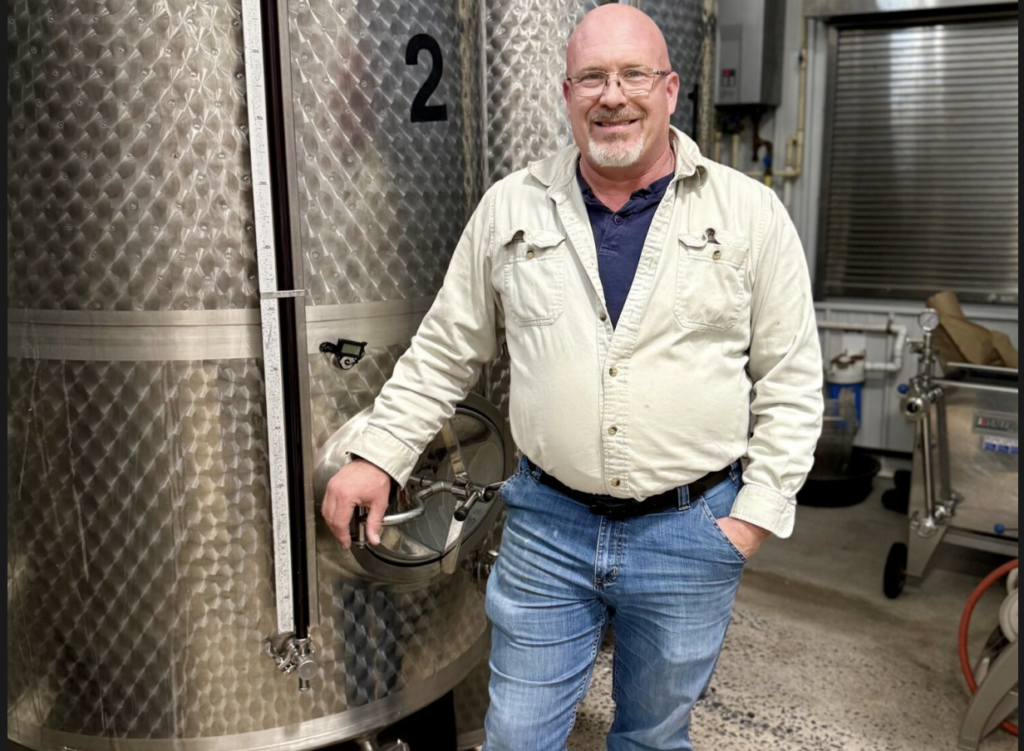
Despite those deep roots, farming wasn’t always part of Layton’s plan.
“I had no desire to be a farmer growing up. It’s not what I wanted to do as a kid,” he said.
Instead, Layton chose a different path, attending the University of Maryland where he earned a dual degree in business manufacturing and logistics. That decision led him far from Dorchester County and into a career with Toyota’s logistics division.
“I wanted to work for a big company in a big city,” Layton said. “I started in Kansas City, then moved to Los Angeles, and then to Cincinnati. I got a lot of good experience.” For eight years, Layton worked as a warehouse supervisor before realizing that something was missing.
“After about six years away, I decided I really wanted to be back here,” he said. “I missed farming. I missed working for myself. I missed being outdoors.”
More importantly, his perspective on home began to change: “As much as I was trying to escape it, I realized what a great place this is to raise kids. This is where I wanted to raise my family.”
Returning to the farm
In 2003, Layton returned to the farm to work alongside his father, growing traditional crops like corn, soybeans and wheat. But it didn’t take long for him to recognize that if the farm was going to thrive, something needed to change.
“As soon as I came home, I realized we were going to need to do something a little different,” he said. “We needed to diversify.”
With limited access to additional farmland, Layton began exploring alternatives.
“We weren’t very good at getting more land,” he admitted. “So, we needed something that wasn’t as land intensive but could still generate income.”
Determined to find the right fit, Layton took a thoughtful approach.
“I made a list of about 50 different things we could do,” he said. “Everything from watermelons and chickens to alpacas and ATV trails. We narrowed it down step by step.” Eventually, that process led to a decision that would change the direction of the farm entirely to grapes and wine.
“We spent two years researching before we ever planted the first grape,” he said. “I went to every beginner grape grower class I could find at the University of Maryland, Virginia Tech and Penn State. I didn’t know anything about it, so I was starting from scratch.”
The first vines were planted in 2007, and by 2010, the winery was open.
‘We try to demystify wine’
Today, Layton manages 15 acres of vineyard and produces a variety of wines that have built a strong local following.
“We’re a very local winery,” he said. “About 60% of our sales are right here in Dorchester and Wicomico counties. People support us because they’re local, and that’s been more than I ever expected.”
One of his most popular wines — Joe’s Cool Red, named after his father — has remained a customer favorite since the winery opened.
Like any agricultural operation, the vineyard faces its share of challenges.
“Last year was one of our lowest yields,” Layton said. “We had a lot of rot in the grapes, and timing is everything. If you don’t get them off when you need to, you can lose the crop.” That experience led to a significant investment in new equipment.
“We ended up buying a mechanical harvester,” he said. “Now we can go out and pick when we need to. I can’t afford to let that happen again.”
Beyond production, Layton has developed a deep appreciation for the science behind winemaking. From monitoring fermentation to evaluating aroma and taste, each step requires careful attention.
“It’s a lot of chemistry,” he said. “Fortunately, I enjoy that. … Wine is very subjective. Everybody picks up on different things, so I’ll have people taste and tell me what they think. That helps make sure everything is where I want it.”
Layton also makes a conscious effort to make wine approachable for his customers.
“We try to demystify wine,” he said. “If you find something you like, drink it with whatever you want. Don’t worry about all the rules.”
‘You’ve got to find a niche’
The support of University of Maryland Extension has played a key role in the success of Layton’s operation. When Layton first began exploring the idea of a vineyard, Extension was one of his first resources.
“Dad was always a big believer in Extension and university research,” Layton said. “He trusted that over what companies would put out.”
“The very first thing we did was have Dr. Joe Fiola come out,” he added. “He looked at our farm and told us where to plant, what grapes would grow, and what would work. Having that kind of knowledge available made it possible for us to start a vineyard.”
Layton continues to value that relationship today, noting that Extension remains a trusted source of research, guidance and support. For those looking to get started in farming, Layton offers practical advice shaped by his own experience.
“You’ve got to find a niche,” he said. “Traditional farming is so expensive to get into. You need something where you can work with smaller acreage and connect directly with customers.”
When he does find time away from the vineyard, Layton stays active and pursues a few unexpected interests, such as running. He’s also an avid reader and comic book collector, often attending conventions throughout the region.
Even with those interests, it’s clear where his passion lies. Like many farmers, Layton isn’t looking toward retirement anytime soon.
“Most farmers keep going until they can’t climb up on a tractor anymore,” he said. For Layton, that future feels a long way off. After years spent finding his way back to the farm, he’s exactly where he wants to be: continuing a family legacy while building something entirely his own.
And if he ever does win that lottery?
“I’d still be right here,” Layton said. “Just with nicer equipment.”